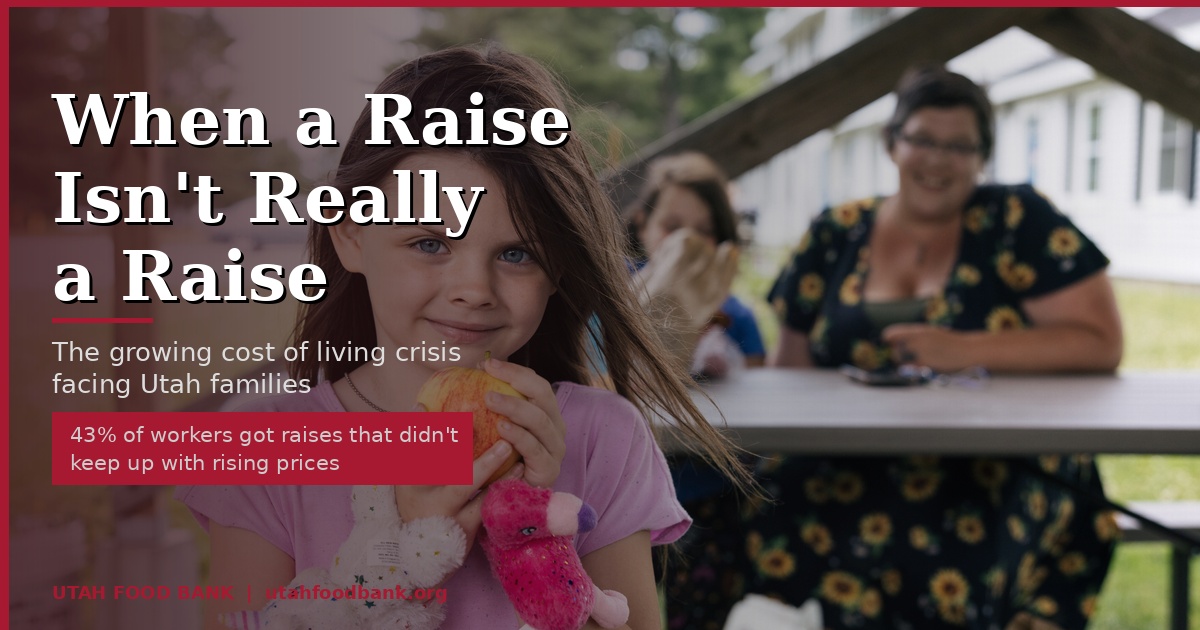
When a Raise Isn’t Really a Raise: The Growing Cost of Living Crisis Facing Utah Families
A raise at work is supposed to feel like progress.
A little breathing room.
A chance to catch up.
A sense that hard work is paying off.
But for many households, the gap between wages and the true cost of living is becoming impossible to ignore. A 4% raise is not a raise if your cost-of-living climbs 6%. And for families already living paycheck to paycheck, that gap is more than frustrating. It is exhausting
The Reality Behind the Numbers
The headline numbers can be misleading.
Recent data shows that 43% of American workers got raises that did not keep up with rising prices. In other words, even though paychecks got bigger, money did not go as far. Nearly half of workers are falling behind because the cost of everyday basics like housing, food, and gas keeps rising faster than wages. The math has been working against working families for years.
Meanwhile, the costs families can’t avoid — housing, healthcare, and childcare — are rising far faster than overall inflation. In 2024 alone, housing costs rose 10.6%, one of the largest annual increases in more than two decades, and childcare rose 7.7%, the largest increase on record.
At the same time, food prices continue to rise nationwide. According to the United States Department of Agriculture Food Price Outlook, grocery costs remain significantly higher than they were just a few years ago, especially for staple items families rely on most.
That means even households doing “everything right” — working full-time, budgeting carefully, planning ahead — are finding it harder to keep up.
At Utah Food Bank, we see what that looks like up close. It looks like a parent putting back fresh produce at checkout. A couple quietly reviewing a grocery receipt, trying to understand how the total climbed so high. A family choosing between filling prescriptions or filling the fridge.
“I just needed a little bridge. A little help to get through. The cost of everything went sky high, and I kept falling further behind. I hate to admit it, but there were times I stood in the grocery store checkout line crying because I could not afford everything in my cart and had to put food back.”
— Wendy, Mobile Pantry client in Layton
These are not rare moments. They are becoming routine.
When “Getting By” Slips Out of Reach
Many of the neighbors we serve are part of a population known as ALICE: Asset Limited, Income Constrained, Employed.
According to research from United For ALICE, households earning above the federal poverty line but are still unable to consistently afford basic necessities.
They are teachers.
Healthcare workers.
Warehouse workers.
Parents working multiple jobs.
They are employed, often full-time, and still struggling to afford food, rent, transportation, childcare, and healthcare all at once.
When costs rise faster than wages, food becomes a negotiable expense. Grocery shopping becomes a game of mental gymnastics: stretching meals, skipping favorites, putting fresh foods back on the shelf, and trying to make too little last just a little longer.
The Grocery Bill Tells the Story
For many families, the grocery store has become the clearest signal that something has shifted. What used to cover a week of meals now stretches only a few days.
That moment at checkout when the total flashes higher than expected is more than inconvenient. It is a turning point. It is where families begin to make trade-offs no one should have to make.
How Utah Food Bank Steps In
The need is rising at exactly the moment when the safety net is fraying. Nearly half of those experiencing food insecurity in Utah don’t qualify for federal assistance, leaving nonprofits like ours to fill the gap.
This is the hunger cliff experts have been warning about: a point where progress stalls or reverses because systemic supports are reduced faster than the underlying need.
At Utah Food Bank, we work to close that gap.
Through programs like Mobile Pantry, Kids Cafe, and our statewide network of 309+ partner agencies, we provide food to neighbors in every corner of Utah. Last year alone, we provided 58 million meals to Utahns facing hunger.
But the need continues to grow as the distance between wages and costs widens.
You Can Help Bridge the Gap
When the numbers don’t add up for families, your support becomes essential. You can make a difference:
- Give Food during local drives or at designated drop-off locations
- Give Time by volunteering at a distribution site or one of our warehouses
- Give Money — where every $1 provides $7.23 worth of goods and services
Host a Summer Business Food & Fund Drive by organizing a food drive with a collection barrel or creating an online DIY fundraiser with your business, workplace, or community group. Your support helps ensure that when a family faces that moment at the checkout line, they have somewhere to turn.
Moving Forward Together
Until wages and affordability begin to realign, food banks, community partners, volunteers, and donors will continue playing a critical role in helping families navigate the gap between working hard and making ends meet.
No one should choose between staying afloat and staying fed. With your support, we can make sure they don’t have to.
Because hunger is not always caused by unemployment.
Sometimes it is caused by costs rising faster than families can keep up.